Peek Inside the Museum
Artefacts for Everyday Practice – Free Downloads
Artefacts to download, experiment with and see what happens next...
Welcome to the free Resources hub in the Solution Focused Museum — a collection of artefacts to spark your curiosity without any commitment. Here you’ll find book covers for quick visual reference, sample pages from our publications (philosophical handouts, exception experiments and research papers) and a few practical infographics exploring SF tools such as miracle questions, scaling, best hopes and exceptions. Drawn from over 30 years of teaching, ethnographic exploration and collaborative insights, these samples offer some hopeful entry points to build confidence hour by hour and make SF work in everyday conversations. Download what appeals to you; no sign-up, no strings.
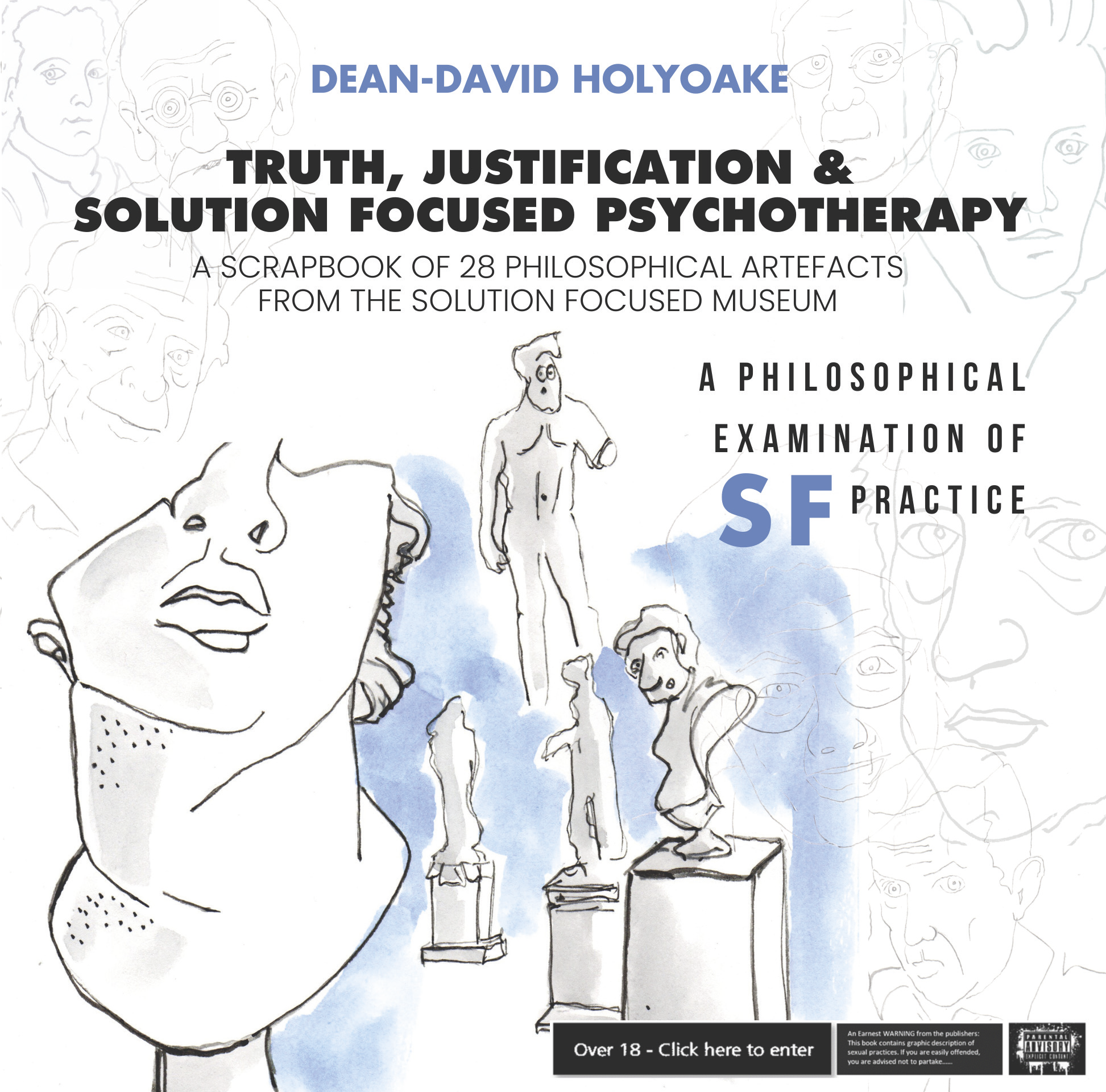
Truth, Justification & Solution Focused Psychotherapy: 28 Philosophical Artefacts from the Solution Focused Museum Dr Dean-David Holyoake’s latest work transforms solution focused practice into 28 contemplated galleries. SF is a future focused approach to psychotherapy (and daily living) which, for me, is packed with theoretical concepts that have never really been exhibited. Constructionism, Pragmatism and Stoicism are 3 philosophies determining the foundations of my SF practice and once I started to consider this I was able to understand why ‘scaling’ does what it does and ‘miracle questions’ ask what they ask. This scrapbook of sketches are my attempt at working out some of these philosophical links to increase my confidence. For 25 years I have attempted to integrate a philosophical foundation to underpin my solution focused practice and the collection of philosophical artefacts I present here have allowed me to work out why SF psychotherapy operates the way it does. I’m suggesting it is possible to start piecing together your own philosophical patchwork and thus, swell your own confidence and SF practice.
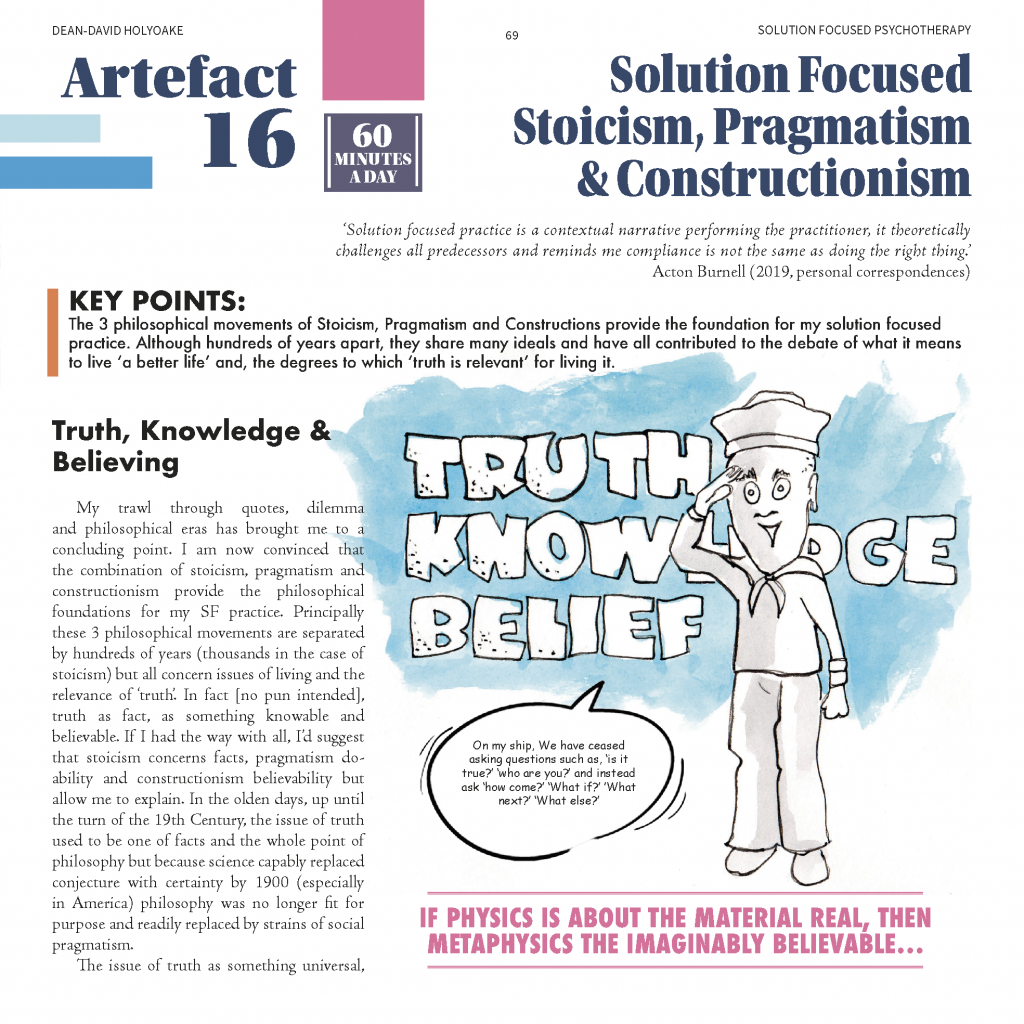
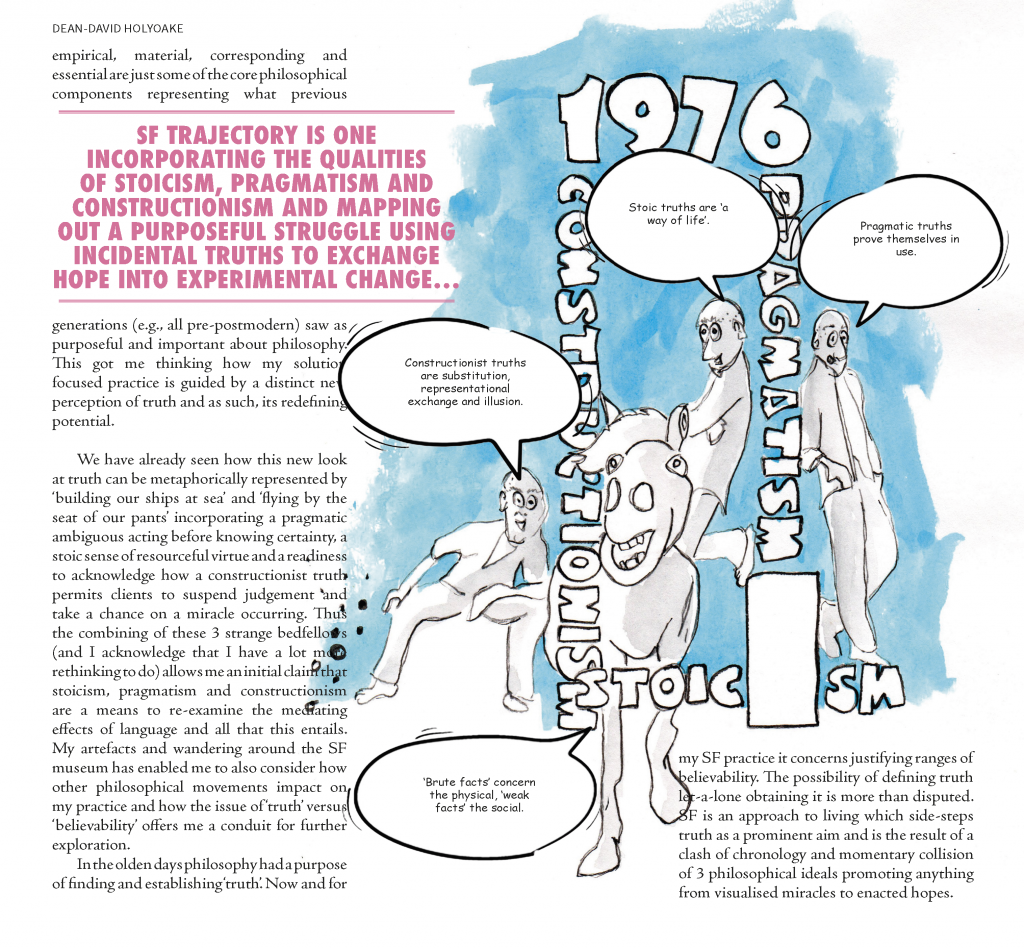
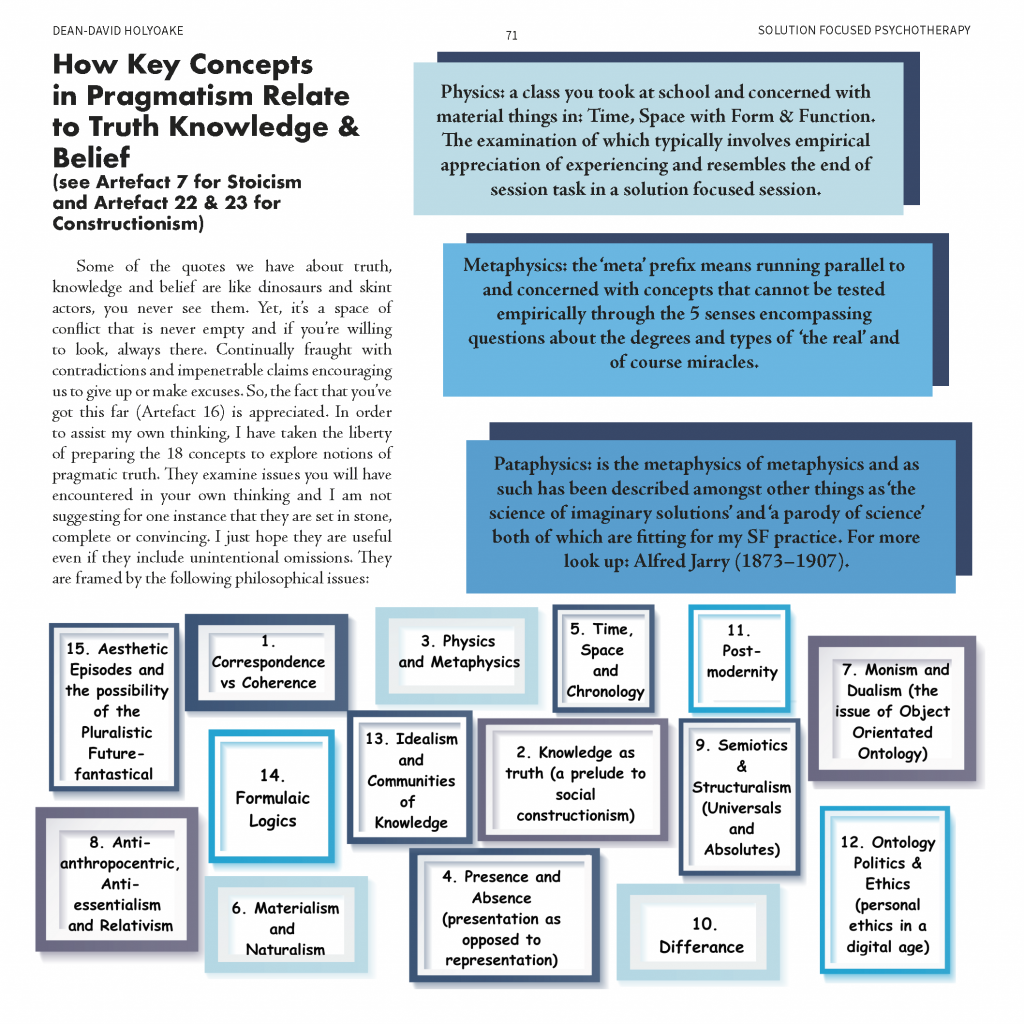
Philosophy isn't baggage...it's the lens that makes SF sharper, stranger and suddenly possible...
Solution Focused Psychotherapy: 24 Philosophical Handouts Discussing Solution Focused Time Dr Dean-David Holyoake discusses the central theme of solution focused practice for time. My mission is to sketch out how solution focused practice (SF) relates to philosophical issues of time. As a future-focused psychotherapeutic approach to therapy, SF helps people contemplate hopeful possibilities, personal potential and predicts change to make things better in their lives. It has tended to avoid over theorising and adopt a mantra of ‘keeping things simple’. So my philosophical sketches about time might not be for everyone, but they have helped me make sense of why and how SF does what it does. My theoretical dabbling is broken up into twenty-four 1 hour segments and drawn from my years of SF teaching and sketches I’ve used to help me think when starting a new conversation about SF philosophy. Some of my ideas require more work, but hey, who knows, with collaboration and enough time anything is possible. Using a model of Biography, Genealogy and Hauntology I suggest that the notion of Past, Present and Future is a useful way to consider SF’s theoretical heritage and one that has certainly helped me conclude that positioning personal change against chronology rather than selfhood is firmly fixed in the postmodern present.
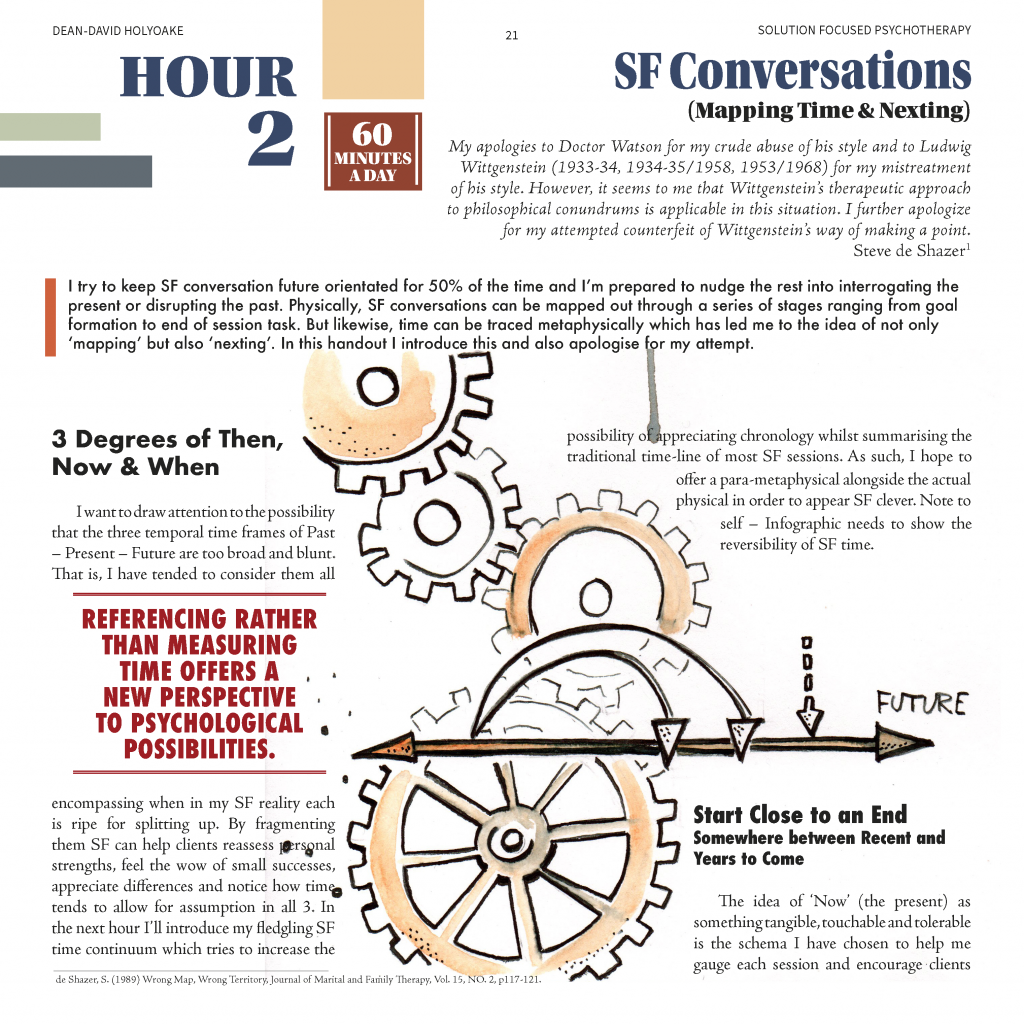
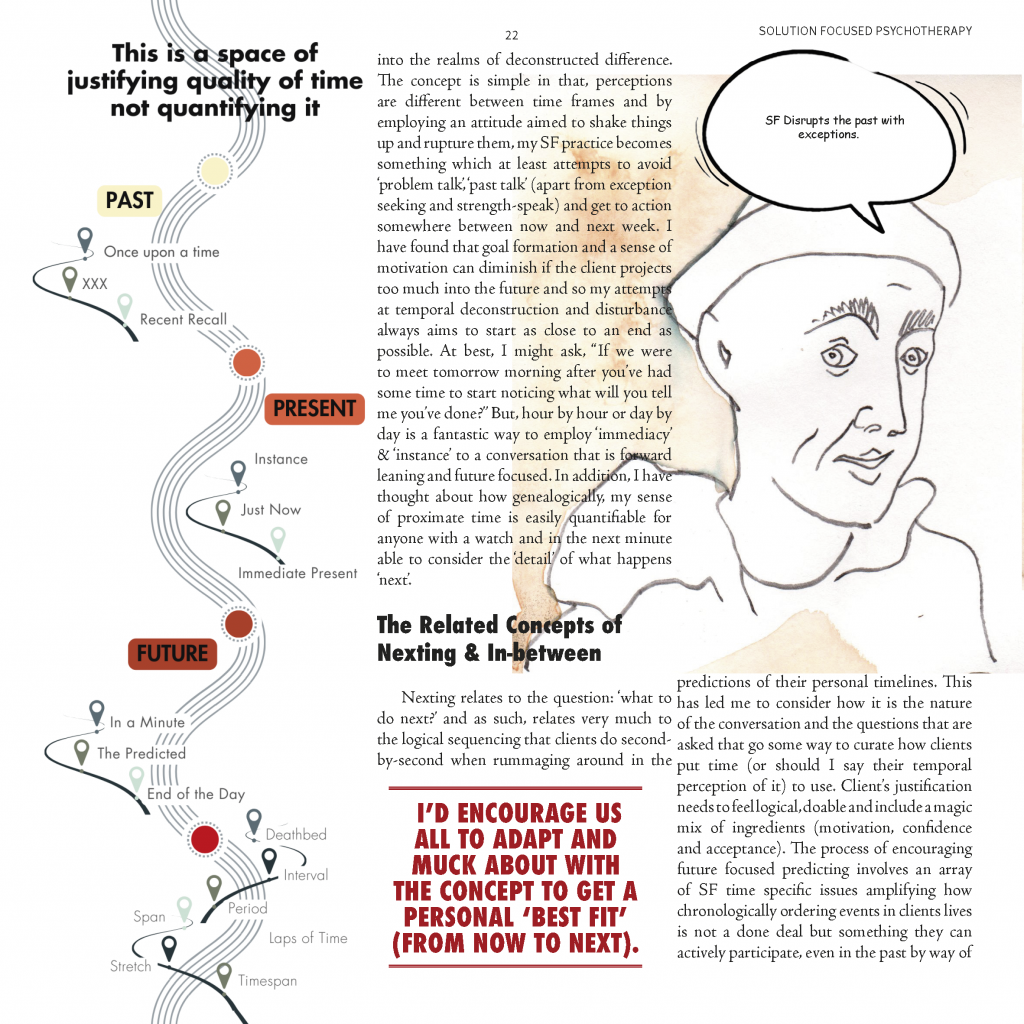
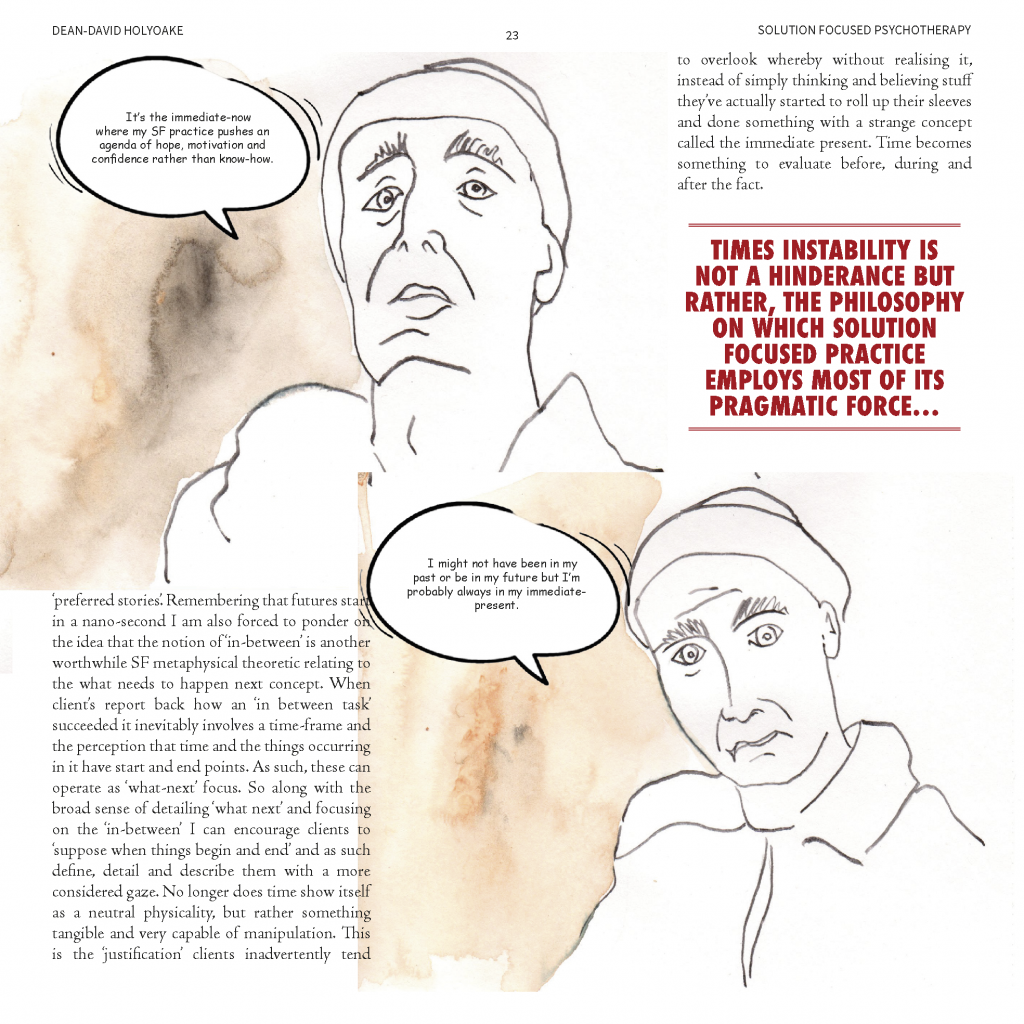
Truth isn't recalled... it's tolerated, justified and made to work...
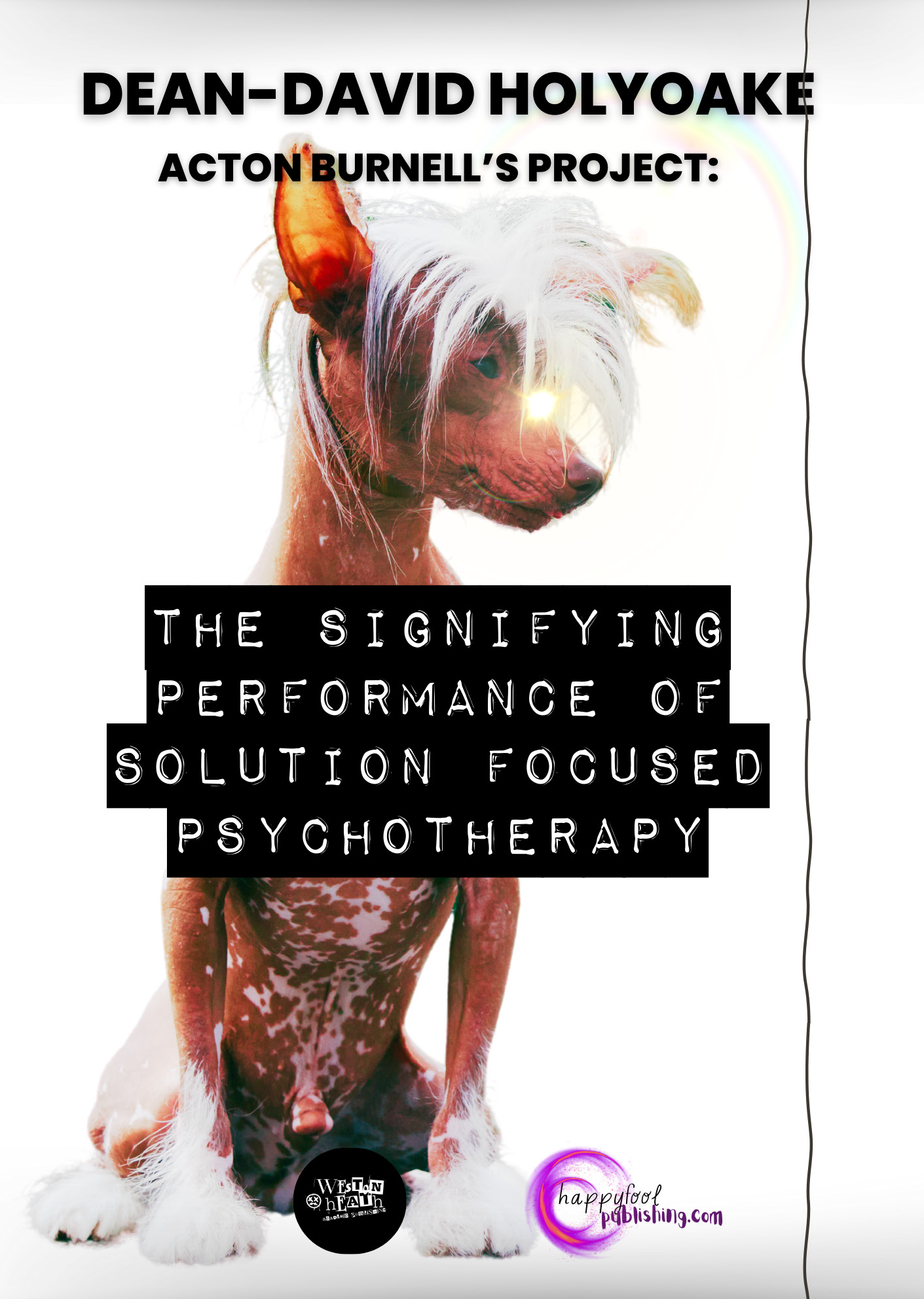
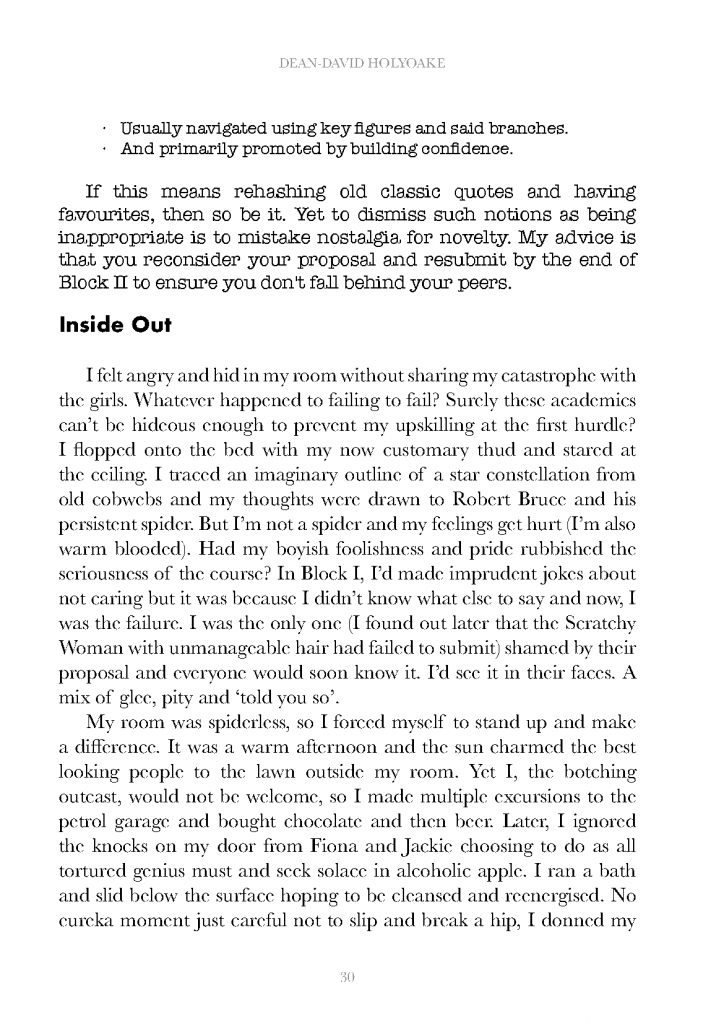
Acton Burnell’s Project: The Signifying Performance of Solution Focused Psychotherapy Dean-David Holyoake’s provocative exploration reimagines solution focused psychotherapy as a signifying performance. Solution Focused practice (SF) is a distinct approach to psychotherapy that emerged during the 1980’s. It is genealogically steeped in pragmatic idealism and social constructionist concepts concerning the structuring and mediating qualities of language. By the year 2000, SF represented a radical challenge to the established psychoanalytic narrative and actively rebelled against the medicalising and the depth conceptualising of psychological wellbeing. At the heart of SF is the belief that to achieve change a client simply needs to do something different and imagine forward rather than overthink their past. It is a can-do approach which adopts stoic pride in its refusal to actively engage in over theorising. So, this project represents something altogether different because it concerns speculative and overtly theorised application of semiotics (the study of signs) to explore what it means to define and appreciate what gives SF its distinct difference and appearance. So don’t buy it if you’re looking for a skills book (there are plenty of better ones about). Acton Burnell has been a practicing psychotherapist for over 35 years. He has worked in several inpatient, outpatient and private settings using an array of psychotherapeutic approaches. His interest in SF started in 1998 since when he has contributed to training and conferences. In this book he and his colleagues enrol on an SF Summer School and find out first-hand how producing an end of term project really isn’t for the faint hearted. Acton works out that the signals of SF, when analysed semiotically perfectly represent the digital moment devoid of authenticity and hauntological futures.
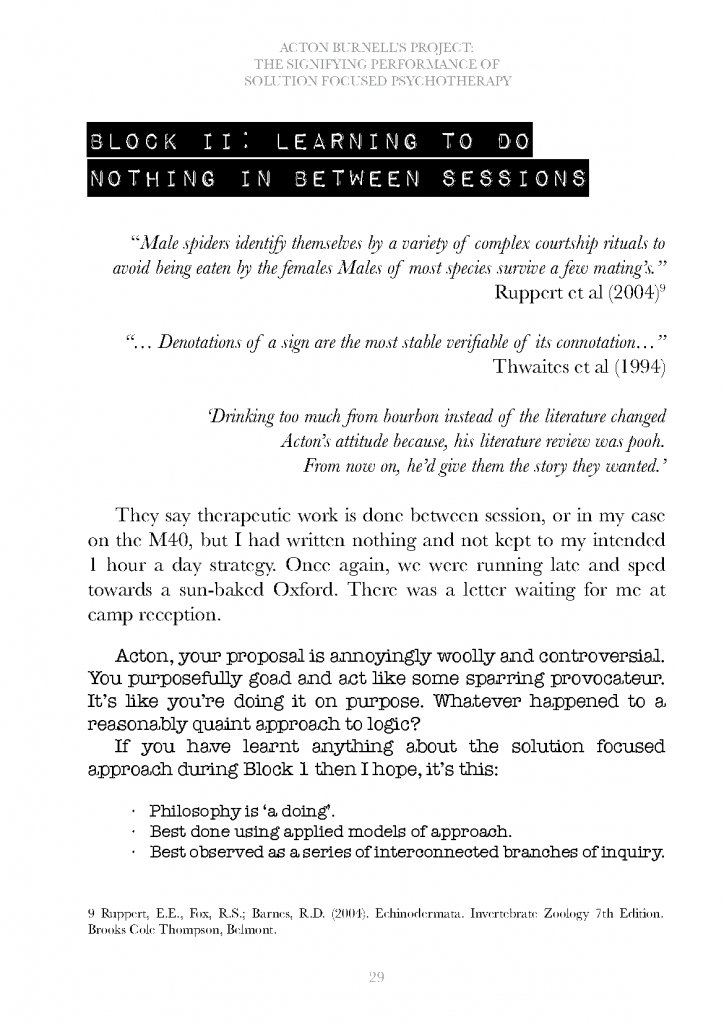
Because truth is what works... and time will tell...
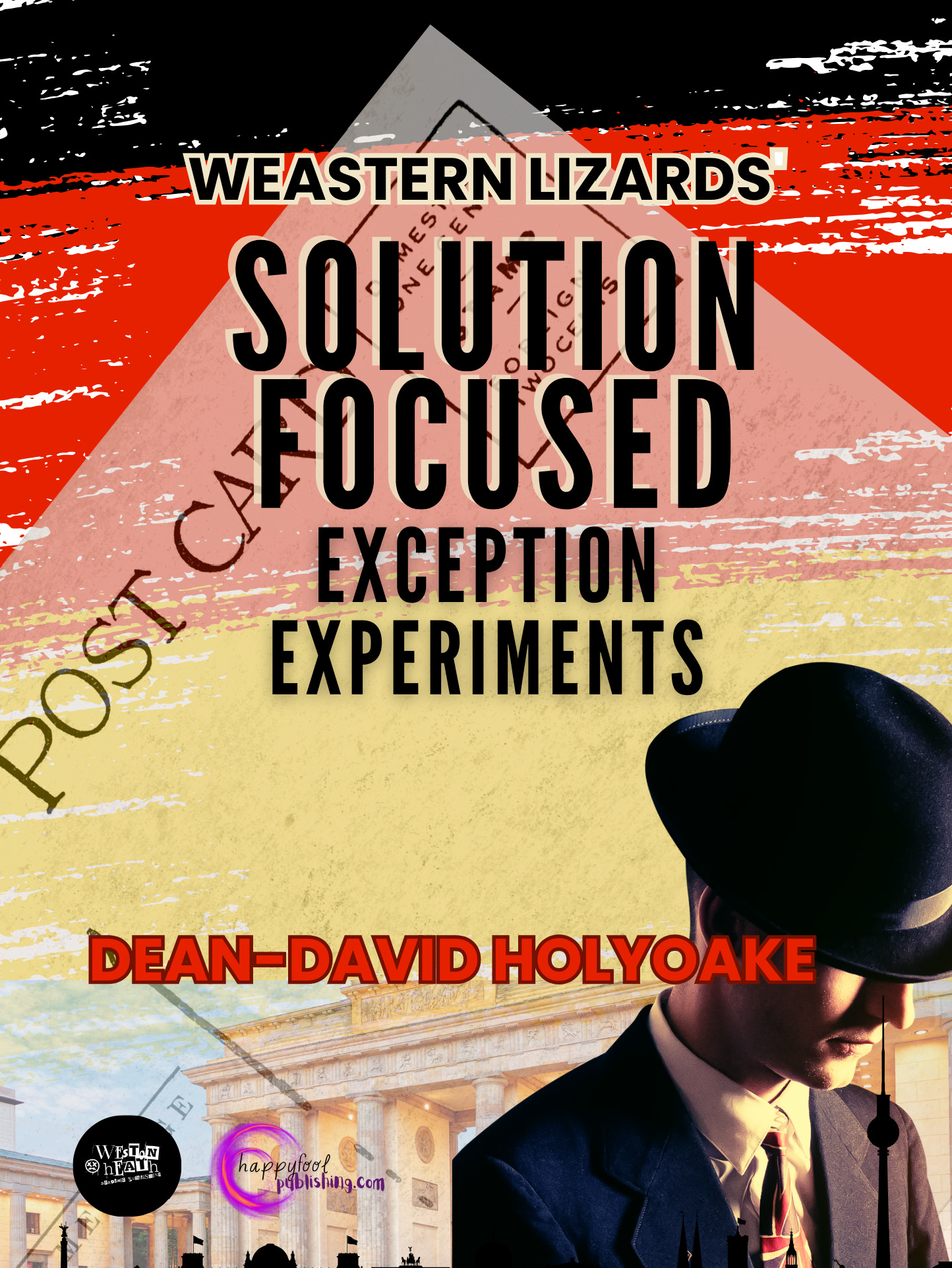
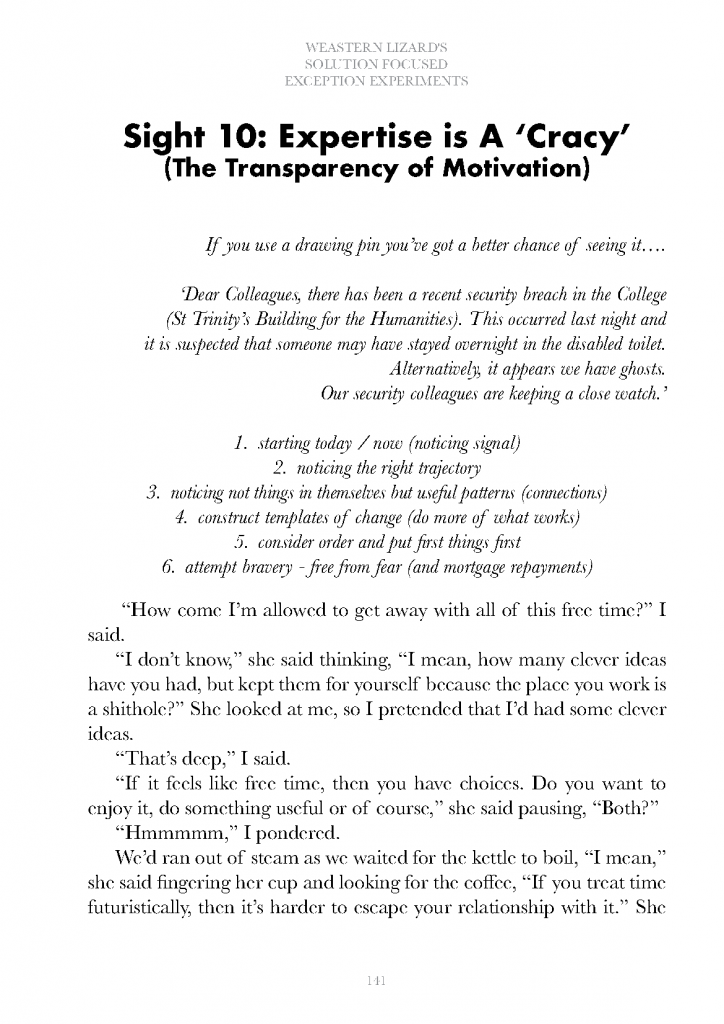
Western Lizard’s Solution Focused Exception Experiments: Sightseeing the Organising Rhetoric of Hauntological Chronology Dr Dean-David Holyoake’s bold re-thinking turns exception-finding into a series of transgressive experiments. Exception Seeking is a key strategy of Solution Focused Practice (SF) that encourages us to consider times when problems should and could have occurred but didn’t. If exception seeking is past-facing then it helps explain why personal biography usually appears as a predictable pattern of defining characteristics. If exception seeking is future-focused it joins the array of tactics SF employs to help us imagine differently. The times when solutions rather than problems could occur as events after-the-fact so to speak. These heavy metaphysical ideals have intrigued Weastern for years and pushed him to wonder if every problem really does have a corresponding solution and if so, how exceptions relate to the predictive aspirations employed by a future fixated approach such as SF? As explained by Weastern himself, “And then it happened, my university employment provided me with the perfect opportunity to start exploring how traces of the past can be rewritten into imagined futures by a daily dose of difference. Exception experiments as self designed tasks requiring me to actively engage in new behaviour to enact personal change.”
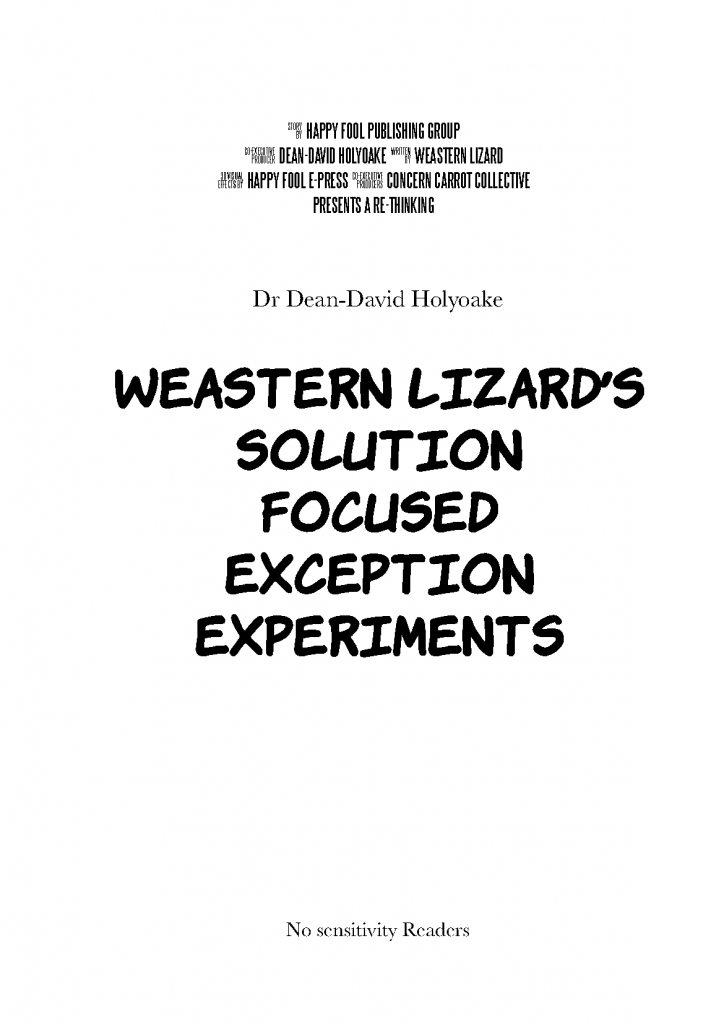
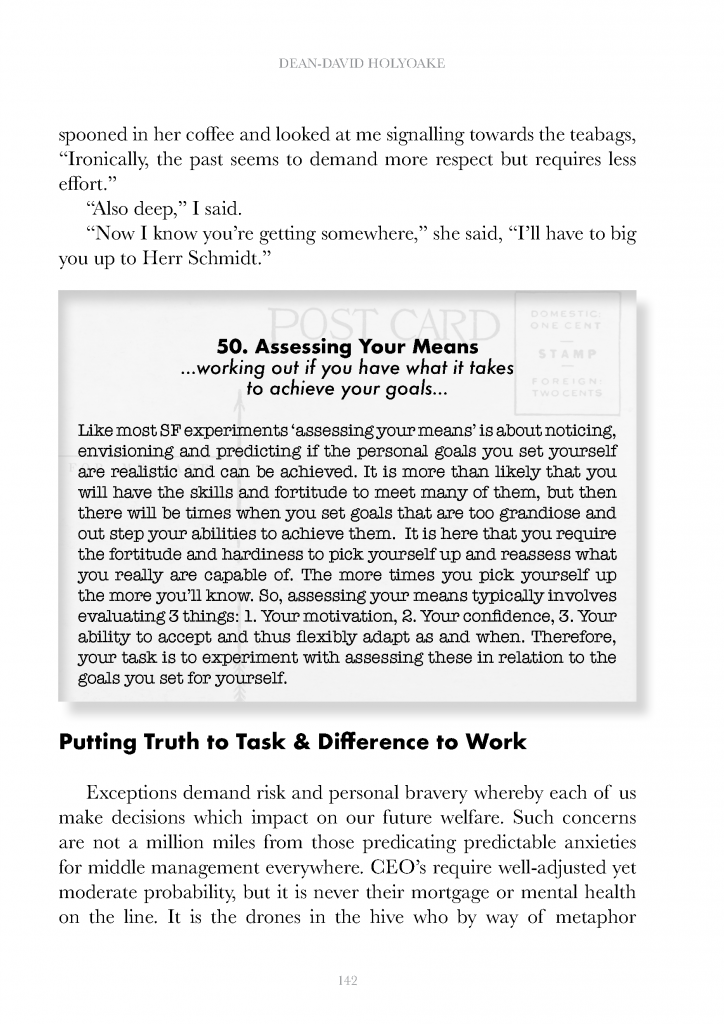
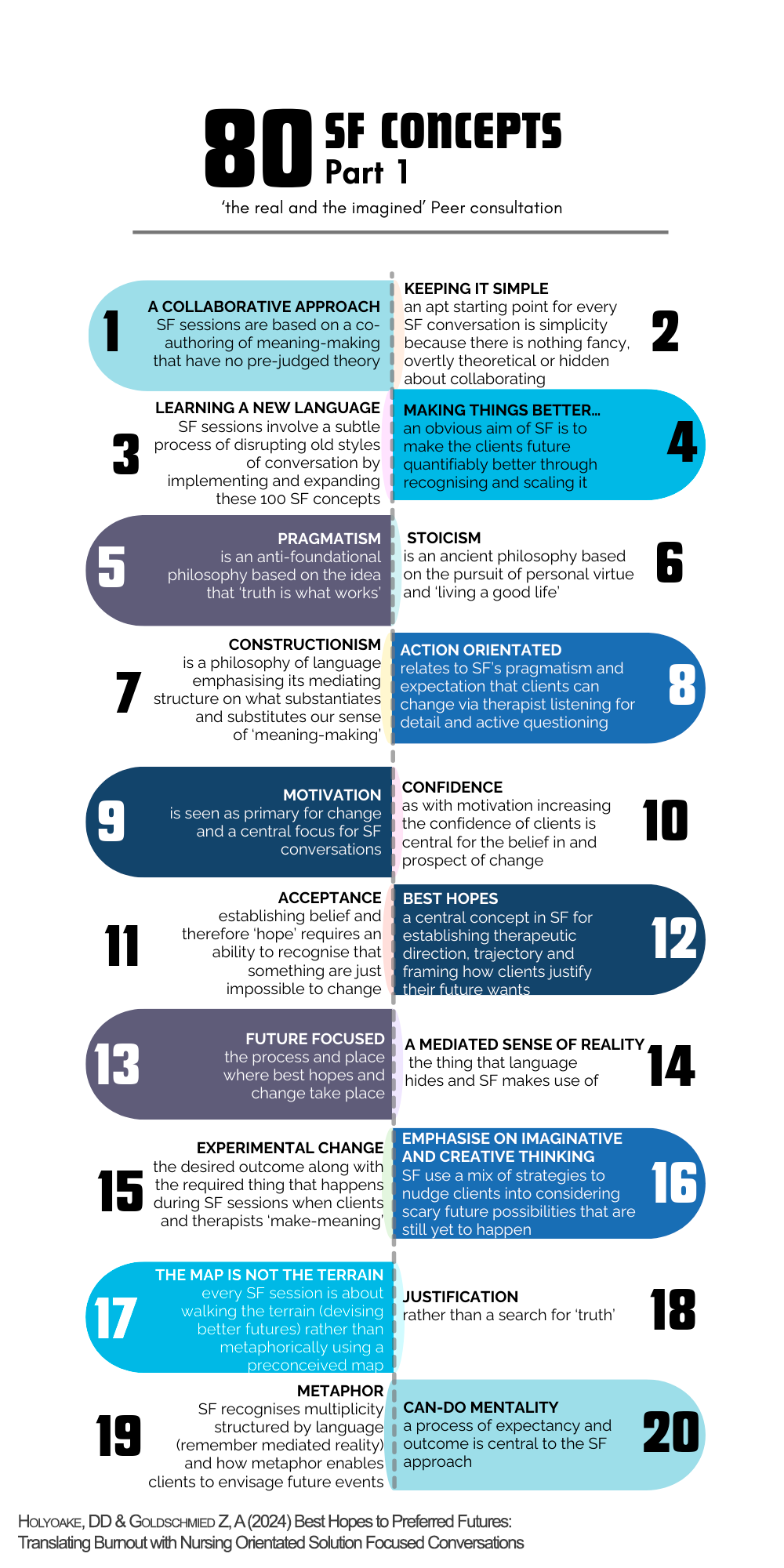
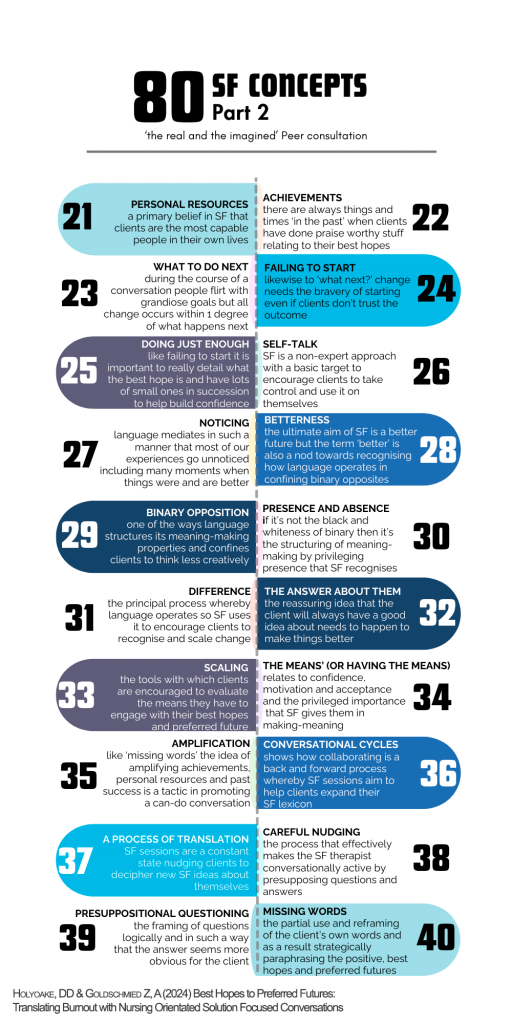
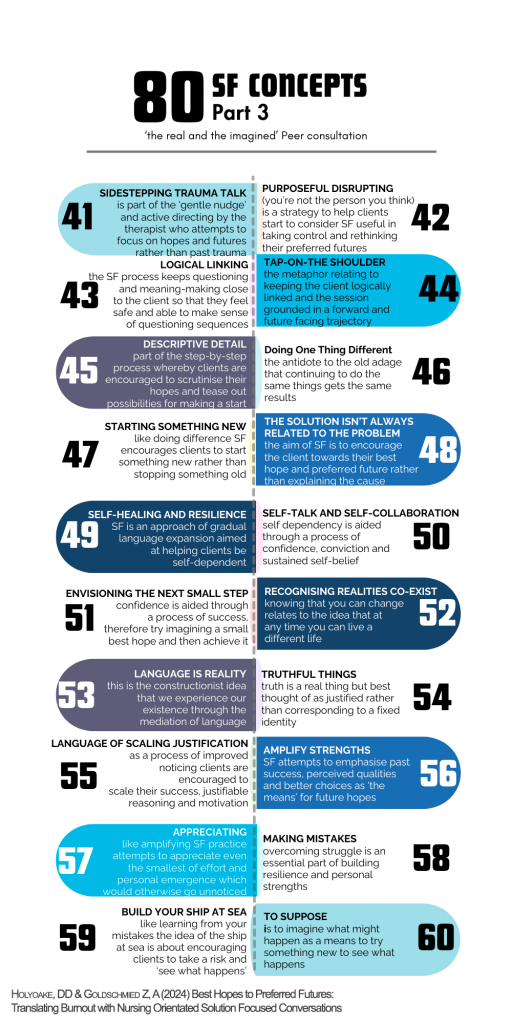
Welcome to the 80 SF Tactics Infographics collection — a visual corner of the Solution Focused Museum where research meets ready-to-use tools. These free, downloadable infographics distil key solution focused tactics from our published work including the 6 tactics for understanding and collaborating with challenging behaviour (“Resisting to Exist & the Subtle Invisible Protest”), burnout translation through nursing-oriented conversations and JOY in therapeutic dialogues. Designed for quick reference in sessions, supervision, training, or teams, they offer simple, hopeful visuals to spark fresh perspectives, build resilience, and make SF practice more accessible hour by hour. No sign-up needed: download, print, share and adapt what resonates.
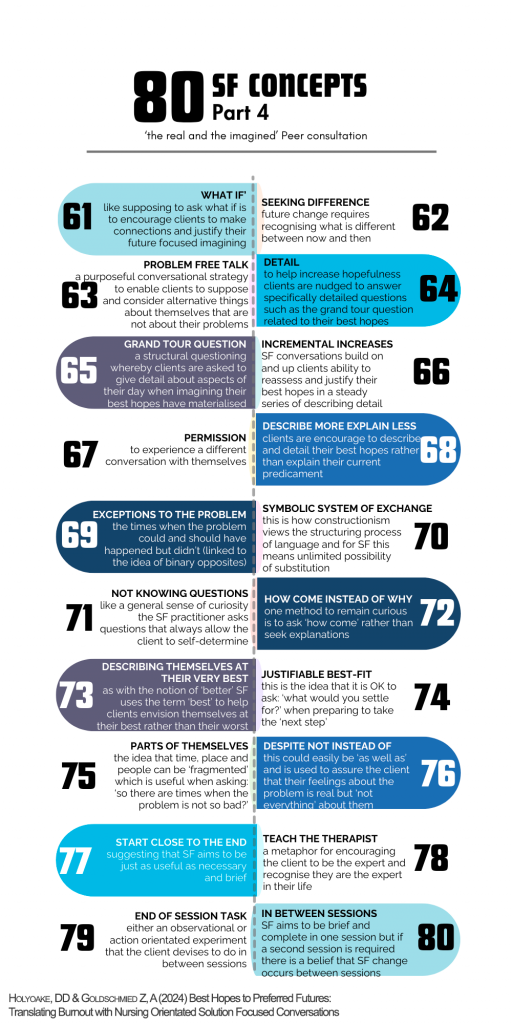
Joy isn't happiness... it's the crack where curiosity slips in and resistance becomes collaboration...
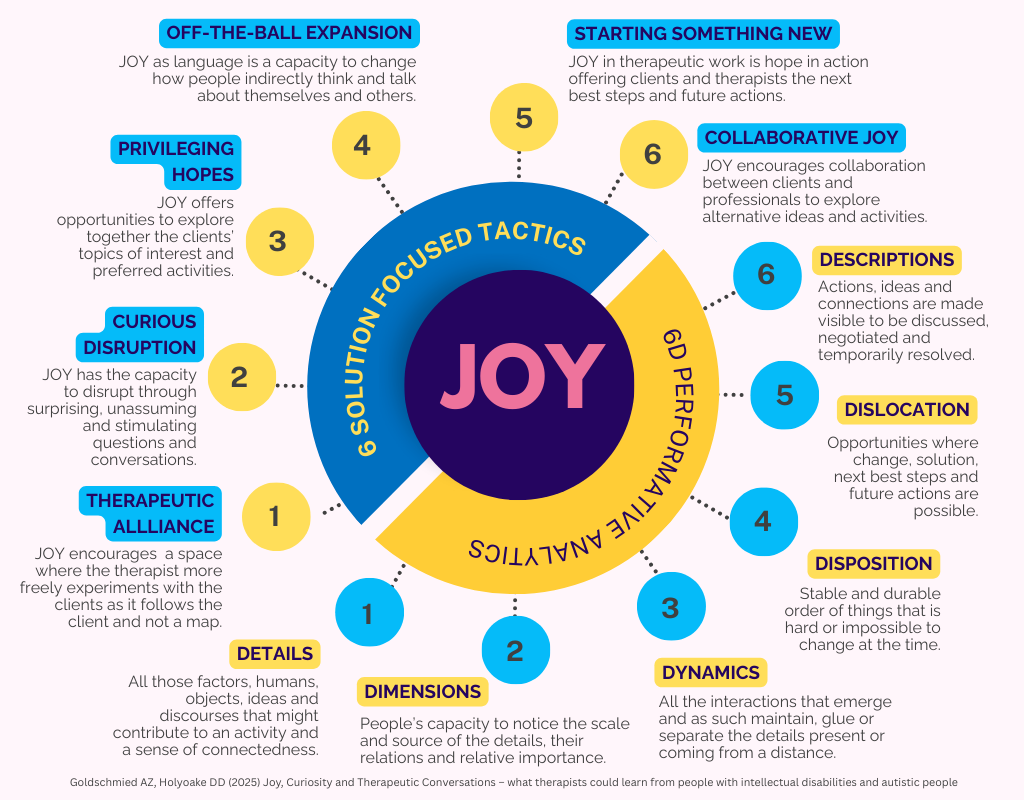
Joy, Curiosity & the 6D Model: Visual Tools for Transformative Conversations
In the Solution Focused Museum, JOY emerges as a transformative concept, distinct from mere happiness or pleasure that invites curiosity, surprise and unknowing into therapeutic work. Drawing from our article “Joy, Curiosity and Therapeutic Conversations – what therapists could learn from people with intellectual disabilities and autistic people,” we explore how JOY alters fundamental assumptions of expertise, history-taking, theories/models, information analysis, therapeutic stance and decision-making. Anita Z Goldschmied 6D Performative Analytical Model (PAM) (details, dimensions, dynamics, dispositions, dislocations and descriptions). PAM provides a structured yet playful lens to recognise these shifts, rooted in actor-network theory and everyday life. These infographics and graphics offer simple visual aids to foster curious solution focused (not solution-forced) dialogues where clients remain the true experts of their lives, promoting fundamental principles of contemporary client-oriented therapeutics: an unknowing therapist, client expertise and joy as the best catalyst for genuine connection and change.
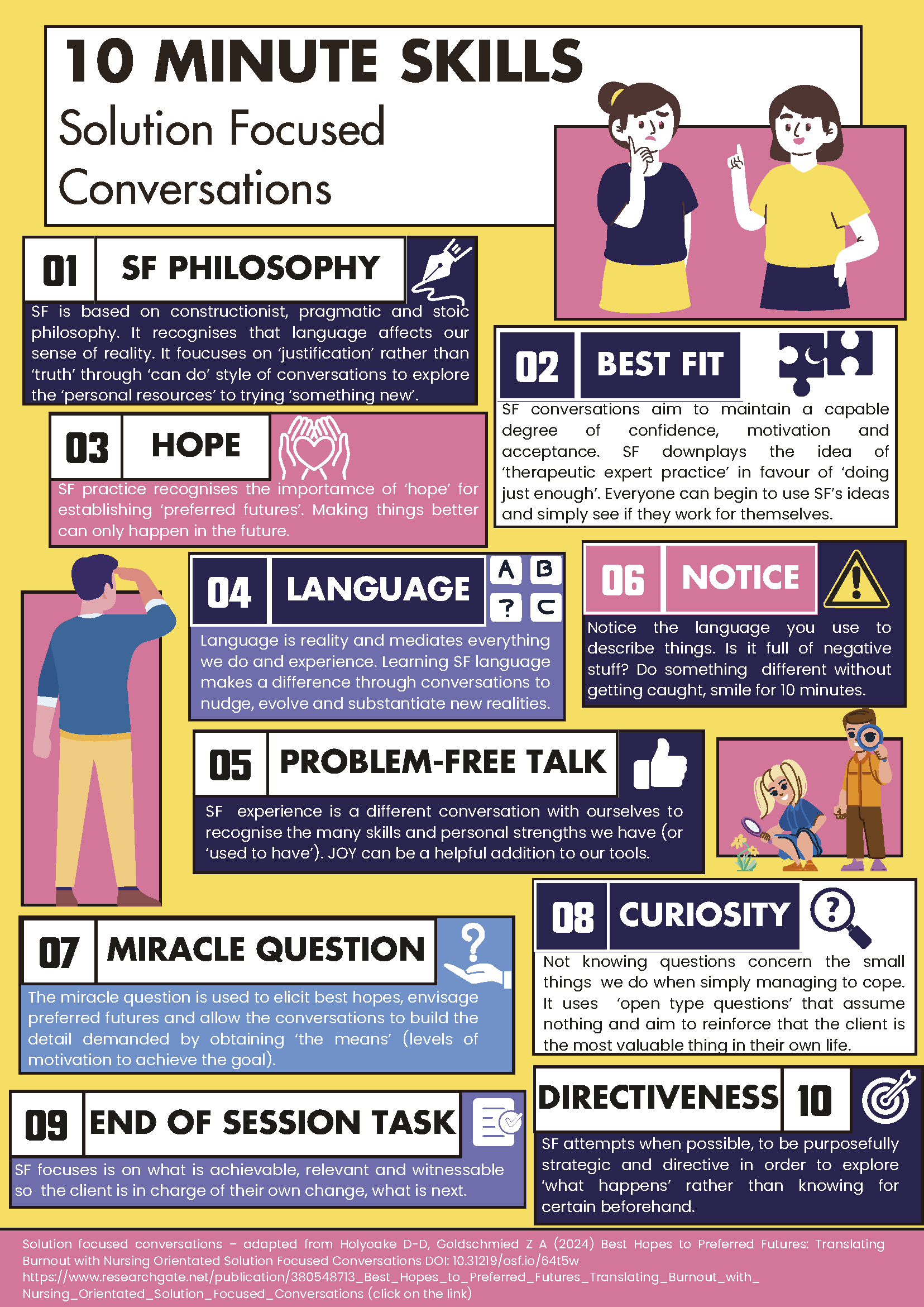
10 Minute Skills: Solution Focused Conversations Infographic
This quick-reference infographic distils 10 essential solution focused conversation skills into a 10-minute visual toolkit. Perfect for busy practitioners, teams or anyone wanting a fast refresh on SF essentials. Adapted from our 2024 “Best Hopes to Preferred Futures: Translating Burnout with Nursing-Oriented Solution Focused Conversations,” it covers philosophy, best hopes, language, problem-free talk, noticing, miracle questions, curiosity, end-of-session task and directiveness (all designed to maintain confidence, motivation and acceptance) while keeping things deliberately simple and future-focused. Download, print or keep on your phone as a gentle reminder that SF conversations can spark change in just minutes. No sign-up required. Take it and see what works.
The museum isn't a building... it's a scrapbook of exceptions where time plays, philosophy nudges and futures perform...
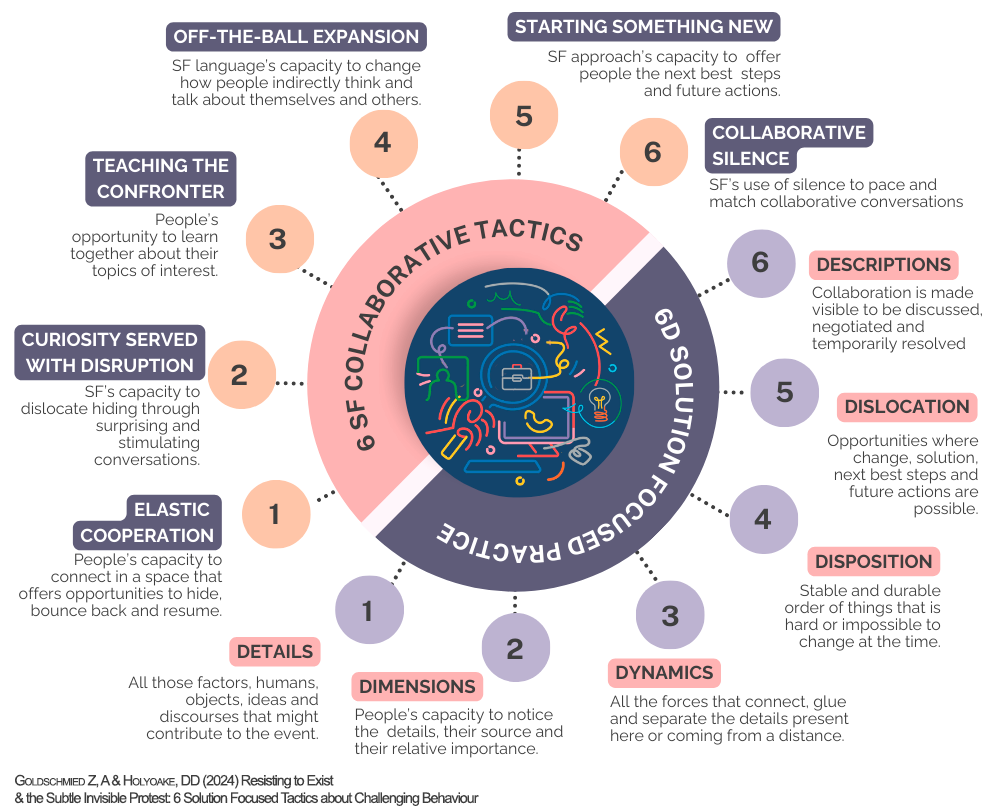
6 SF Tactics for Reframing Behaviour Infographic
This visual toolkit brings the 6 solution focused tactics from our 2024 paper “Resisting to Exist & the Subtle Invisible Protest” straight into everyday practice. A simple, hopeful way to reframe behaviour as subtle protest and collaboration rather than resistance to overcome. Designed for quick reference in sessions, teams or supervision, the infographic highlights how SF conversations can mirror staff experiences, turn triggers into opportunities and build resilience hour by hour using Anita Z Goldschmied 6D lens (details, dynamics, dimensions, dispositions, dislocations, descriptions). Download it freely, print it, pin it up – no sign-up, no pressure – and let these tactics spark fresh, less confrontational conversations that recognise young people (and teams) as capable humans navigating high arousal in their own way.